Your support people spend hours sorting tickets. Operational teams fix data by hand in different apps. Sales is slow because the same pieces of information are looked for three times. In fact, combine these small day-to-day issues with a slowdown, and they all add up to more expense.
Bosses have one big choice. They can hire more people to handle the mess, or they can build systems that plan, decide, and do stuff on their own more and more. AI agents are right in the middle of that choice.
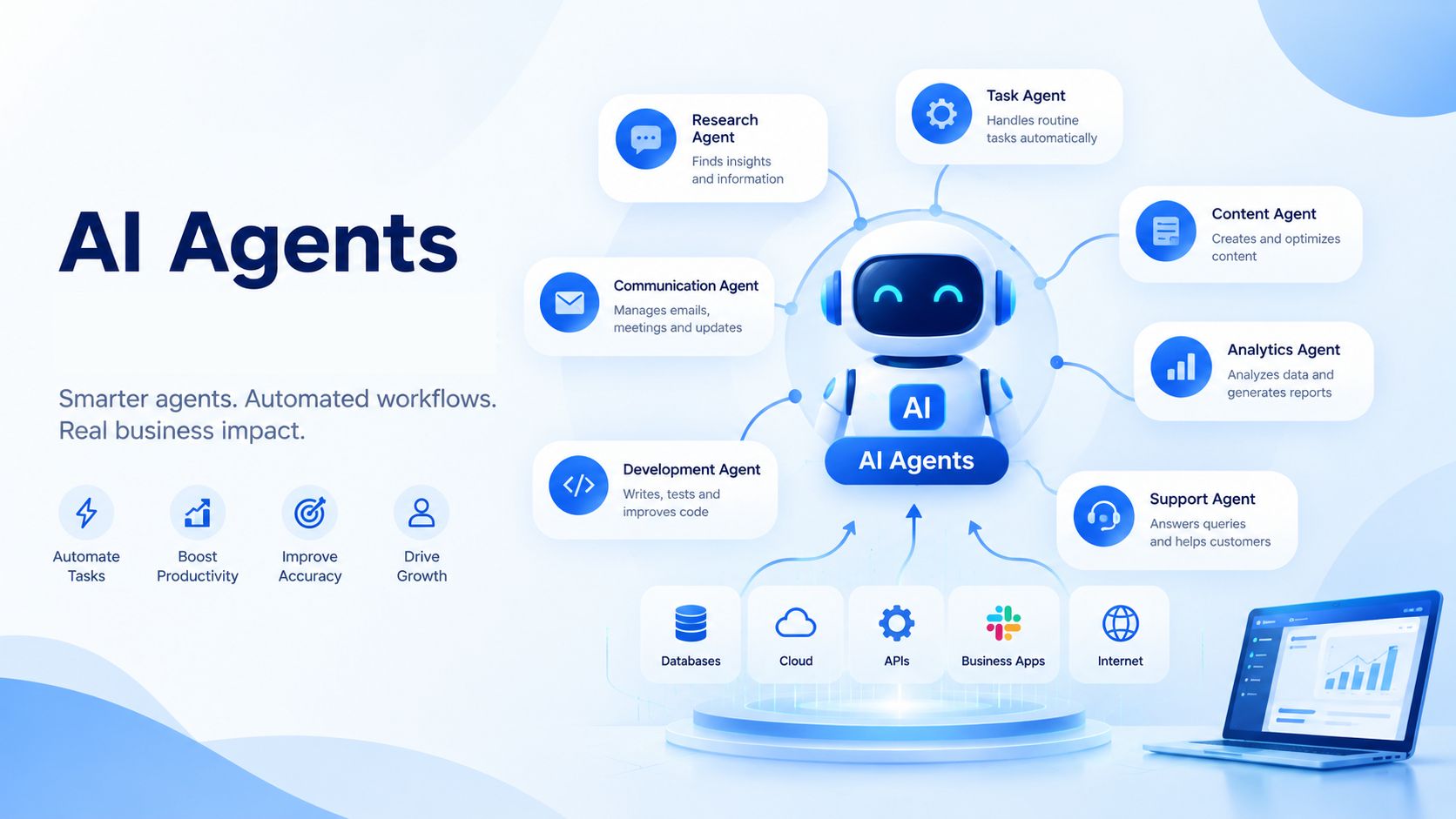
The agents might expose vulnerabilities and high expenses, as well as safety and security issues. The right agent setup (done properly) from the start allows things to move quickly and gets you ahead of the pack.
This guide explains what it is. It covers which patterns fit different business needs and lists what leaders must evaluate before development begins.
1.What Is AI Agent Architecture?
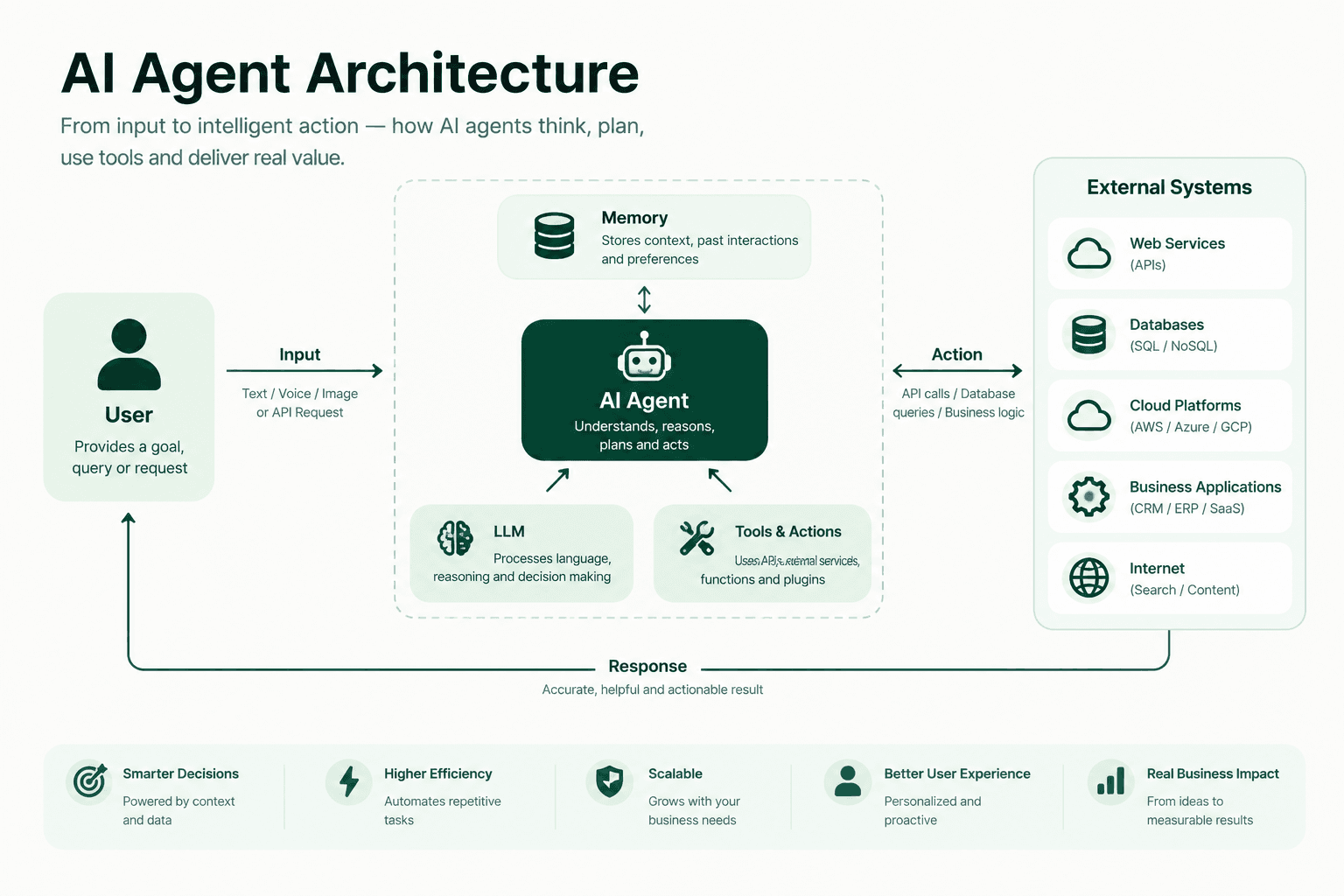
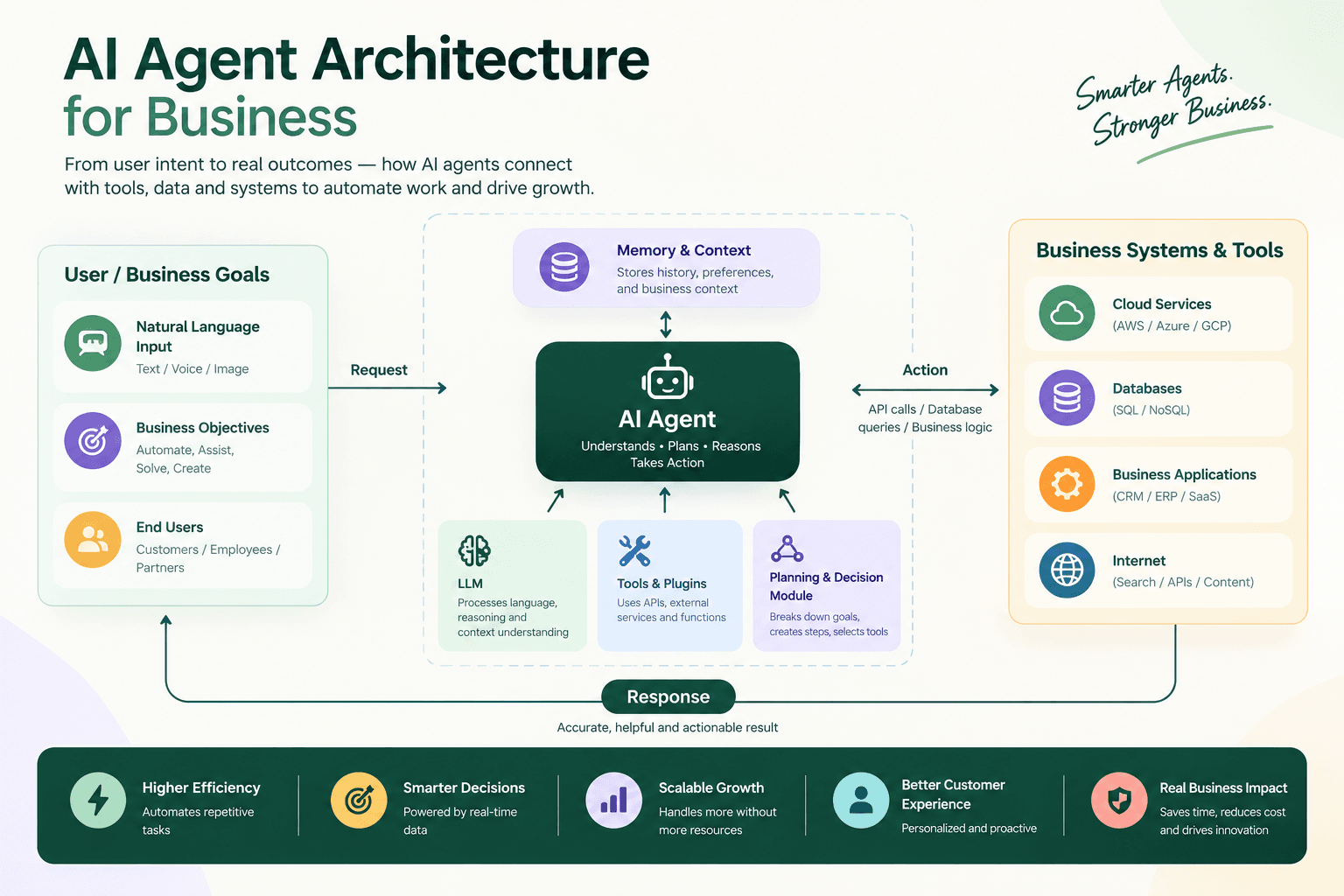
AI agent architecture is the full blueprint. It lets software pursue a goal. This agent investigates on to how is it done and uses the right tools. Remembering what it did to secure its goals in the previous iteration and acts within boundaries.
An ordinary chatbot only provides the right answer for one question before being silent. An agent will keep running as long as the job does not end. Or it hands the job back to a person. The language model supplies the thinking power. The architecture supplies the structure. That structure turns thinking into reliable business results.
2.AI Agent Architecture vs. Traditional AI Architecture
Traditional systems and agent systems solve different problems. The table below shows the practical differences.
Area | Traditional AI Architecture | AI Agent Architecture |
Main job | Answer questions or generate content. | Pursue goals and complete multi-step work. |
How it works | One prompt leads to one response. | Continuous loop of plan, act, check, adjust |
Memory | Limited to the current chat | Short-term task memory plus long-term facts |
Tools | Optional and limited | Central to getting real work done |
Control | Mostly inside the model | Strict external rules for security and policy |
Business value | Helps people work faster | Takes whole processes off people’s plates |
Risk level | Lower because it only suggests | Higher because it can change live systems |
3.Key Components of AI Agent Architecture
Every production agent rests on a set of working parts. These parts must fit together.
3.1.LLM and Reasoning Layer
This is the brain. It understands language and thinks through steps. Many companies add a gateway that picks the right model for each step. Easy steps use cheaper models. Hard steps use stronger ones.
3.2.Memory and Context
Short-term memory contains information about what is happening now. Long-term memory contains all of the other important information and past results that have been gathered through many different times. If an AI doesn't have good memory, then it may lose track of important information.
It repeats work. Clean designs keep these two types of memory separate. They apply clear retention rules.
3.3.Tools and API Integration
Tools let the AI model perform actions. They can update a CRM, check open inventory, and pull numbers from a database. Modern setups use standard protocols. These protocols enforce login rules. They restrict permissions and rate-limit how frequently tools may be called.
The reliability of the tools is one of the most important factors that facilitate how accurately models provide helpful returns.
3.4.RAG and Knowledge Layer
Retrieval-augmented generation gives the agent correct company data. Vector stores and knowledge graphs hold verified facts. This helps to ensure that the AI does not create false responses.
3.5.Agent Orchestration
When there is a need to combine input from several experts, it is required to have an AI agent orchestrating the process. The AI agent will control the flow of the work.
It will allow for the transfer of ownership between experts, take advantage of the results produced by each expert, and transform the separate capabilities of the experts into a unified working system.
3.6.Monitoring and Observability
Every decision must be recorded. Every result must be recorded. It records how quickly teams ship, the cost of what they're building, its success rates, and drift. Good observability lets problems surface early. They surface before they affect customers or operations.
3.7.Human-in-the-Loop
Not every action should run alone. High-stakes decisions benefit from clear approval gates.
4.How Do You Choose the Right AI Agent Architecture for Your Business?
These are the key points that help businesses to choose the right architecture.
- Describe everything, such as steps, decisions, tools, and risk level.
- For simple high-volume tasks, single-agent design works very well.
- Complex or regulated work usually needs hierarchy. Or it needs multiple agents plus human checkpoints.
- Fully open agents deliver the highest efficiency. But they demand mature testing and controls.
- Bounded agents with clear limits often deliver faster returns.
Now, moving forward, here are three questions you should be asking.
- What does it all mean for business?
- Which systems must the agent access?
- What will doing badly cost everyone?
That trains you in the correct usage and manner of control.
5.What Should Businesses Consider Before Developing AI Agents?
Define solid business objectives.
Set a desired target. Be clear in what a successful outcome means for you concerning saved hours, avoided costs, etc. Data quality determines the utility of results.
You select a model depending on both cost-benefit analysis and speed. Most of the companies use multiple models for different parts of their task.
The ability to integrate with the present IT environment is an important element.
At the stage of preparation, a detailed list of interfaces should be formed.
Building an agent is based on what type of security or regulatory requirements you have.
Design for future growth so that when it wins, the system can grow.
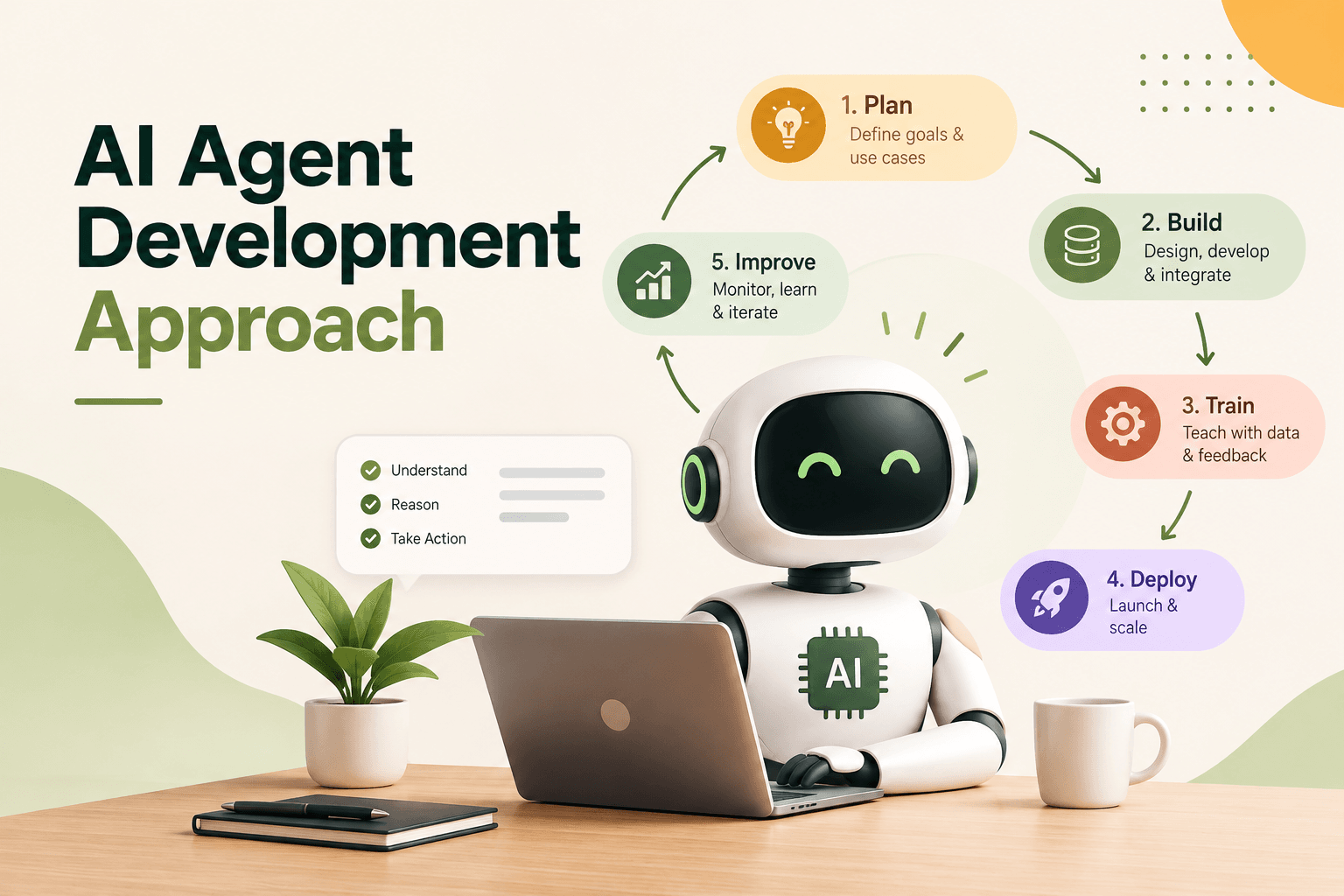
6.How to Develop a Secure and Scalable AI Agent Architecture?
Picture a system that suggests actions. But it never makes the final change on its own. That separation is the foundation of safe scale.
- Keep the model’s ideas apart from the systems that write data and move money.
- Enforce every permission outside the model.
- Nothing stays hidden; log every important step.
- Irreversible actions must be approved by a human operator.
- Incorporate continuous evaluation into the platform.
- Performance stays visible this way.
Begin with tight boundaries. Keep them closed until the numbers show the system is ready.
This transforms an experimental agent into a trusted daily operation.
7.How Much Does AI Agent Development Cost?
Costs vary based on things like complexity, integrations, compliance needs, etc. This is a grounded, realistic view based on current ranges.
Agent Type | Typical Build Cost | Monthly Running Cost | Typical Timeline |
Simple single-task agent | $15,000 – $50,000 | $500 – $2,500 | 4 – 8 weeks |
RAG + tool-using agent | $40,000 – $120,000 | $1,500 – $5,000 | 8 – 14 weeks |
Multi-agent system | $150,000 – $350,000 | $5,000 – $15,000 | 4 – 8 months |
Full enterprise platform | $300,000 – $600,000+ | $10,000 – $30,000+ | 6 – 12+ months |
Key factors that move the cost up or down include:
Factor | Impact on Cost |
Number of system integrations | Each solid integration adds 10k–30k. |
Compliance and audit needs | Can add 20–40 percent |
Custom model work | Adds 20k–50k |
Human-in-the-loop design | Modest increase for higher reliability |
Observability and evaluation | Essential but often underestimated |
8.Common Challenges and How to Avoid Them
Companies face many hurdles while developing any AI agent. Understanding them early helps. Building solutions into the design saves months of pain later.
8.1.Security threats
Prompt injection may cause data leakage. Doing things in an unapproved way may result in unwanted steps happening.
Solution: Filter inputs and outputs. Keep authorization outside the model. Limit every tool to the smallest necessary permission.
8.2.High LLM costs
Token usage goes up faster than expected. The bill surprises everyone.
Solution: Route simple steps to cheaper models. Set tight budgets. Cache repeated results. Limit unnecessary loops.
8.3.Latency
Users wait too long for answers. The experience feels slow.
Solution: Run independent steps in parallel. Use faster models for routing decisions. Design workflows that can show progress early.
8.4.Multi-agent complexity
Coordination becomes messy. One agent’s mistake spreads to the others.
Solution: Add agents only when specialization clearly helps. Keep handoffs simple. Avoid failures cascading by isolating them in one place.
9.Build, Buy, or Hybrid: Which AI Agent Development Approach Should Businesses Consider?
You can decide where custom work creates real advantage. You can also decide where ready platforms save time.
Approach | Best When | Main Advantages | Notes |
Buy/Adopt platform | The use case is common, and speed matters most. | Faster start, lower upfront effort |
|
Build custom | The process is unique, or the data is highly proprietary. | Full control, competitive differentiation |
|
Hybrid | Some parts are common, others are strategic. | Balance of speed and uniqueness |
|
10.Time to Summarize!
The real value of AI agent architecture shows up in shorter cycle times. It shows up in lower operating costs and people available for higher-judgment work. That value only surfaces if the architecture is intentional. Mapping the process is the best way to let them pick the right pattern.
While guarding security and cost from failing experiments, keep results on track towards reliable systems. Those that bypass architecture go back into pilot mode. Most everything that follows is determined before the development starts.
11.Commonly Asked Questions Along With Their Answers
Read these additional questions to know more about the architecture of an AI agent.
Q1. What is the difference between single-agent and multi-agent architecture?
Ans. A single agent handles the whole task with one set of tools. On the other hand, multi-agent systems use specialists.
Q2. What technologies are used to build AI agents?
Ans. Teams combine foundation models. They use:
- Orchestration tools
- Vector databases for retrieval
- Secure tool protocols
- Identity systems
- Observability platforms chosen to fit existing infrastructure.
Q3. Are AI agents secure for enterprise applications?
Ans. Yes. Security sits outside the model through strong permissions. It uses input filtering, scoped tools, full logging, and human approval for risky actions.
Q4. What is the difference between AI agents and chatbots?
Ans. Chatbots mainly answer questions. Meanwhile, agents pursue goals across multiple steps. They use tools, maintain state, and operate within clear boundaries.