A laptop sits in a warehouse for three weeks. Nobody knows who should approve its release. A finance director finds out, at quarter-end, that fifteen expensive assets left the building with no approval on record. An IT manager spends half a Monday chasing an email thread across four teams just to confirm one server upgrade.
These are not rare accidents. They happen every day in enterprises that still use manual or single-person approval systems for their assets. As companies grow across departments, cities, and vendors, the question of "who approves what" stops being small talk. It becomes a real business risk.
Asset management covers a wide range these days, such as software licenses, hardware, vehicles, factory gear, and office space. When one person holds all the approval power, or when there is no clear process, problems appear. Compliance gaps open up. Money gets wasted. Decisions take longer than they should. Competitors who do not have these slowdowns simply move ahead.

That is exactly where multi-level approval workflows step in. They put clear, role-based checkpoints into every stage of an asset’s life. Purchases, transfers, and disposals, all of them have to clear the right people before anything becomes final.
This piece walks through why these workflows have become non-negotiable for solid enterprise asset management. You will see the actual business benefits, how the process plays out day-to-day, and how to put it in place.
1.What Is a Multi-Level Approval Workflow in Asset Management?
A request does not get a single yes or no from one person. It moves through several people, and each one looks at a different angle before the request can go forward.
Just suppose a team wants new servers. First, the department head gets the request and checks whether the team really needs them. Then, the IT asset manager reviews the technical side. Finally, finance looks at the budget. Only after all three say yes does the purchase move ahead.
That is a clear step up from a basic setup where one person controls the whole decision. Spreading the audits across the appropriate roles builds accountability right into the process instead of leaving it to chance.
There are several core components you should also include to make it work smoothly.
- Trigger refers to whatever starts the process, usually a new asset request.
- The approval chain is the specific order of people who need to review and sign off.
- Conditional routing consists of simple rules that send the request down different paths depending on cost, type of asset, location, or risk level.
- The audit trail is a clean record of every approval, rejection, and comment, complete with timestamps.
- Escalation means that if someone sits on a request too long, it automatically moves to the next person.
2.Why Single-Person Approvals No Longer Minimize It
Big organizations simply do not operate the same way small companies do. One manager can handle approvals just fine when they only watch over ten assets. The same approach falls apart when you have thousands of assets spread across many teams, each with its own budget and its own set of risks.
2.1.The Problem With One Person Deciding Everything
Giving approval power to a single person means that the whole company inherits that person’s blind spots and schedule. What happens when they are out on leave? What happens when they are slammed and rush through the details? There is no second set of eyes to catch a mistake before an asset gets bought, moved, or written off.
Auditors notice this kind of concentration of power quickly, especially in various fields, such as healthcare, finance, and IT. Regulators expect clear separation of duties in these sectors. Not even a single person can control an entire high-value decision from start to end.
2.2.Size Changes the Calculation
Imagine a company tracking 5,000 assets across ten different offices. Trying to run that through email threads or hallway conversations just does not work. There are too many requests flying around. Manual tracking cannot keep up. Multi-level workflows handle that volume in a way human memory and overflowing inboxes never will.
3.Why These Workflows Actually Pay Off
Leaders change them when the numbers add up. Multi-level approval workflows offer substantial value in four practical areas, such as compliance, cost control, speed, and visibility.
3.1.Tighter Hold on Costs
Every asset that comes in or goes out carries a price. Without a solid process, it becomes far too easy for teams to order more than they need, place the same order twice, or push something through that exceeds the budget before anyone notices.
A multi-level setup checks the cost at more than one stage. The department head confirms the actual need. Finance confirms the budget still has room. That extra set of eyes consistently cuts down on wasteful spending because no single person is making the call alone.
3.2.Stronger Compliance Base
Other industries such as banking, healthcare, telecoms, and manufacturing have to demonstrate they control how assets are acquired, employed, and eventually decommissioned. It tracks who requested the asset and who approved it with precise timestamps.
The audit record makes for a tidy data export where there would have been only frenzied scrambling when the auditors showed up. Whereas organizations that have these systems enjoy audits where they get through quickly and with far less drama than those still left relying on paper trails and memory.
3.3.Decisions Move Faster
A lot of people assume more approval steps automatically mean more delay. Reality is different once the process is automated. Manual approvals crawl because someone has to remember to forward an email. Automation workflows push the request forward instantly, ping the right person right away, and escalate on their own if nobody responds in time.
You end up with more checkpoints but a quicker overall process. Nothing is left waiting because someone forgot to follow up.
3.4.Clear View for Leadership
Executives rarely have time to dissect every individual transaction. They need the macro: which teams are asking for the most assets, where the delay is building up, and to which approvers you are a bottleneck. Solid approval software hands them that dashboard. Asset management shifts from pure administrative work into something that actually helps strategy.
4.How a Multi-Level Approval Workflow Actually Works
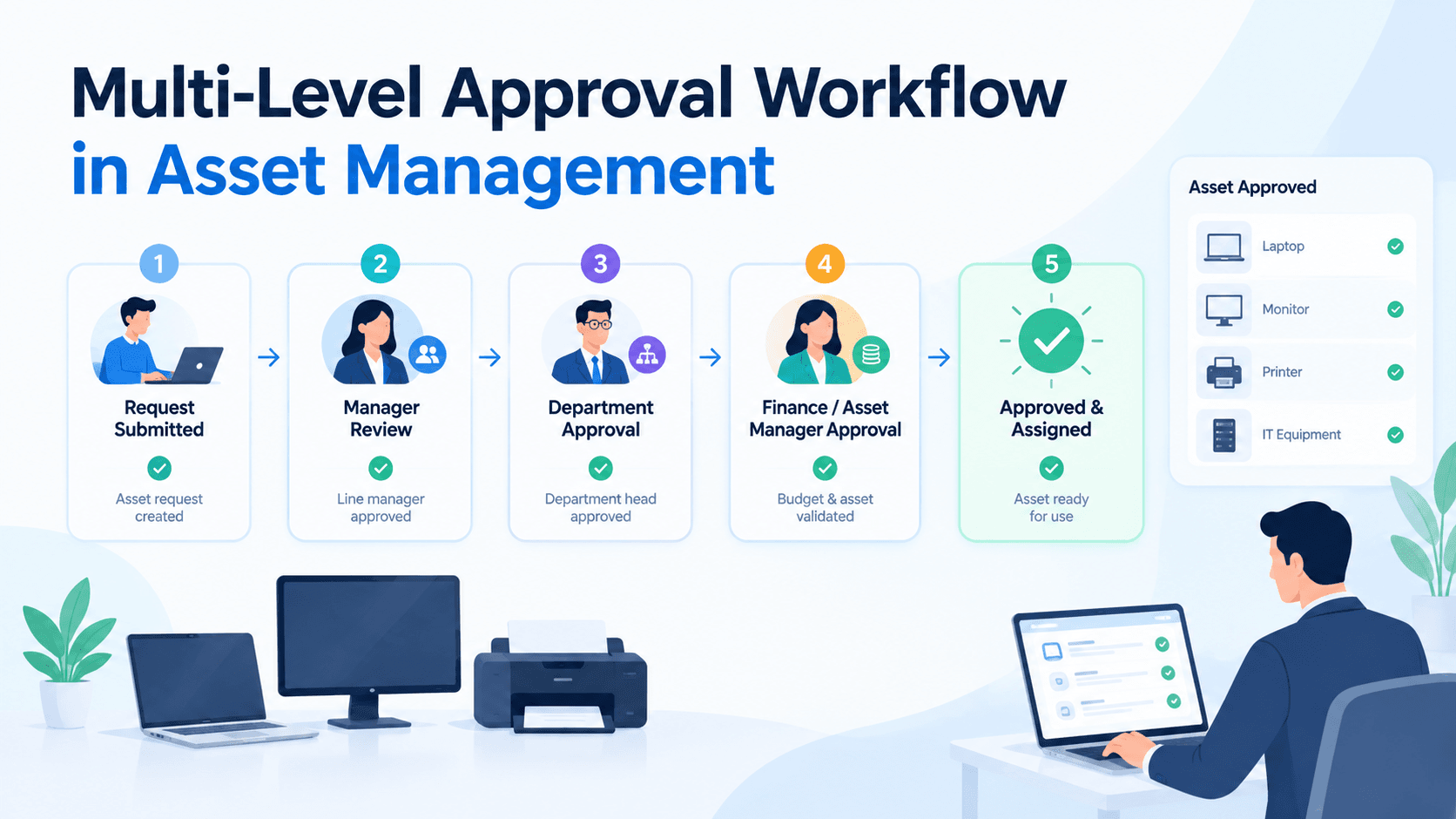
Let’s walk through the following process to see how it actually works out. An employee needs a new laptop approved.

Step 1: Someone Starts the Request
An employee or team requests new assets, like laptops for incoming hires. It automatically fills out the important bits: what you are asking for, the approximate cost, why you need it, and which team is making the request.
Step 2: First Check by the Team Lead
The direct manager looks at whether the request actually makes sense for the team’s current needs. This step quietly kills premature requests, already covered, or simply not justified yet.
Step 3: Asset Manager Review
The IT asset manager compares the request against what is already sitting in inventory. Quite often, this single step prevents a new purchase. There might already be an unused laptop somewhere that can be reassigned.
Step 4: Finance Takes a Look
Finance checks the request against the available budget. If the amount is high enough, it may go up further to a senior finance leader or the CFO for final confirmation.
Step 5: Action and Clean Records
Once every approval is in place, the request moves into procurement. Every step, including who said what and when, is logged automatically.
The same flow works just as well for disposals, transfers between teams, and maintenance on expensive equipment. The people change depending on the situation, but the core idea stays the same: layered checks and clear ownership.
5.Real Situations Where This Saves Real Money
These are the common situations where multi-level approval workflows save real money.
5.1.Stopping the Same Gear From Being Ordered Three Times
One large company with offices in different regions discovered that three separate teams had each ordered the exact same batch of networking equipment. Nobody had visibility into what the other teams were doing. A required check by the asset manager would have flagged the overlap long before the second and third orders went through.
5.2.Keeping Expensive Equipment From Disappearing Too Early
Factories regularly retire heavy machinery or specialized tools. Without a proper approval chain, valuable equipment sometimes gets disposed of too soon, or worse, with no paperwork for tax or compliance. A multi-level disposal workflow forces finance, compliance, and operations to all sign off before anything leaves the books.
5.3.Reducing Unused Software Licenses
A lot of enterprise software renews on its own unless someone actively cancels it. A well-built workflow requires both the team still using the software and the finance team to confirm the renewal. That simple step stops companies from paying for licenses that have been sitting unused for months.
6.Wrapping It Up
Multi-level approval workflows are no longer just something for big, bureaucratic companies. They are a practical answer to the way most businesses actually operate now: multiple teams, people in different places, tight budgets, and more rules than ever. Getting asset decisions wrong through duplicate orders, early disposals, or missed compliance steps costs real money, and those costs stack up fast once you reach any real scale.
Organizations that put automated approval chains in place tend to see three consistent shifts. They waste less money on unnecessary purchases. They prepare for audits with far less stress. Decisions move quicker because the right people get notified and gently pushed instead of relying on someone remembering to follow up. The companies that treat these workflows as a genuine business tool rather than just more paperwork are the ones that can keep growing without growing their risk at the same rate.
7.Most Commonly Asked Questions Along With Their Answers
Check out all these additional questions on why multi-level approval workflows matter within enterprise asset management.
Q1. Why should one be concerned with multi-level approvals instead of just one person?
Ans. One person becomes both a bottleneck and a single point of failure. Spreading the checks across department heads, asset managers, and finance means no major decision hangs on one person’s calendar or judgment.
Q2. Which asset decisions usually need this kind of review?
Ans. Large purchases, disposals, transfers between teams, software renewals, and maintenance contracts that sit above a certain cost threshold. Those are the most common triggers.
Q3. How does this help when auditors show up?
Ans. The system automatically builds a timestamped record of every approval step: who approved what and when. Audit prep turns from a frantic hunt for emails into a simple export of the data.
Q4. Do you follow extra steps just to slow everything down?
Ans. Not when the process is automated. Manual chains crawl because people forget to follow up. Automated ones send notifications immediately and often finish the whole cycle faster, even with more checkpoints.
Q5. How many levels should we actually use?
Ans. It depends on the value of the asset, the risk involved, and any regulatory requirements. Start with your highest-risk categories, map the natural decision points, and avoid adding steps that do not clearly improve control or accountability.
Q6. What is the smartest first move?
Ans. Write down exactly how approvals happen today, even if the process is informal and messy. That shows you the gaps and the unclear ownership. It also makes sure the new automated version matches how your business actually works instead of some perfect introductory version.